
Google logged the August 2026 Google Spam Update on 18 August and marked it complete on 21 August. Since then a lot of site owners have looked at a sagging Search Console chart, checked the date, and drawn the obvious conclusion.
The obvious conclusion is probably unprovable. Between 13 August and 30 August, at least four separate and independently documented things happened to Google Search. Only one of them was the Google Spam Update. One of them was not a ranking event at all, and one of them changed what the phrase “manual action” even means depending on where your reader is sitting.
That is the actual problem in front of anyone diagnosing a decline right now. Not “what does a Google spam update target,” which is answerable in a sentence, but “which of the four things that happened this fortnight is the one on my chart.” Getting that wrong is expensive, because the remedies point in opposite directions. Sites that respond to a reporting artefact by gutting their content library do real damage to themselves. This is the kind of question a structured SEO audit and recovery process exists to answer, and it starts with separating what Google actually said from what the industry inferred.
So let us separate them.
What Google confirmed, and what it did not
Google’s Search Status Dashboard records the incident precisely. The August 2026 Google Spam Update began at 09:27 Pacific on 18 August 2026 and ended at 01:49 Pacific on 21 August 2026, a duration of 2 days and 16 hours. The release note states that the update applies globally and to all languages.
That is the entirety of the confirmed record for the August 2026 Google Spam Update. Google published no accompanying blog post, named no targeted tactic, disclosed no share of affected queries, and did not say which of its spam policies the update strengthened.
One correction is worth making, because a “fastest Google Spam Update yet” framing circulated in the days after launch. It was not. Checked against the dashboard’s own ranking history, the March 2026 Google Spam Update ran 19 hours and 30 minutes, the June 2026 Google Spam Update ran 2 days and 1 hour, and August ran 2 days and 16 hours. August was the longest of the year’s three, not the shortest.
What a Google spam update does in general is documented. Google describes Google spam updates as notable improvements to the automated systems that detect search spam, and points to SpamBrain, its AI-based spam-prevention system, as an example of the machinery being refined. Sites that see a change are told to review the spam policies. That is a description of a category, not a description of this specific rollout. Treating the general documentation as if it explained the August event is the single most common error in the coverage published so far.
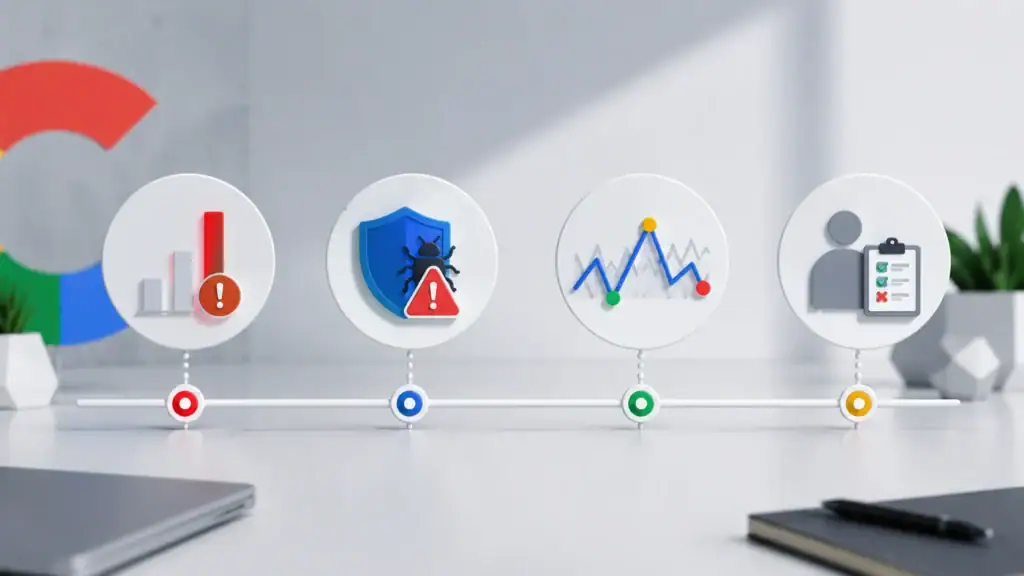
Four events, one traffic chart
Here is the fortnight as the primary sources record it.
Dates | What happened | Source | Ranking event? |
13–17 August | Logging error suppressed impressions in the Generative AI performance report in Search. A related error hit the Discover report for 13 August data. | Google Search Console data anomalies page | No. Reporting only. |
18–21 August | The August 2026 Google Spam Update, global, all languages, 2 days 16 hours. | Google Search Status Dashboard | Yes. |
Late August onward | Third-party trackers and SEO forums reported continued volatility after the rollout closed, and earlier spikes around 1–3, 5–6 and 12–13 August. | Search Engine Roundtable, third-party volatility trackers | Unknown. Google has confirmed nothing. |
28–30 August | Google announced that manual actions under its site reputation policy would stop applying to searchers inside the European Economic Area from 30 August. | Google Search Central Blog | Yes, but only for a specific policy and a specific audience. |
Four events. One chart. Every one of them will be blamed for somebody’s decline this month, and at least one of those attributions will be wrong.
The unconfirmed volatility deserves a note. Third-party tools registering movement is evidence that results moved. It is not evidence that Google shipped a named update, and it is certainly not evidence that a Google spam update caused any particular site’s decline. Barry Schwartz at Search Engine Roundtable documented continued turbulence after 21 August and observed that it looked like a separate unannounced update. That is an experienced practitioner’s read of tracker data and community reports. It is a third-party observation, and it should be carried as one.
The baseline problem almost nobody has mentioned
Now the part that changes how you measure.
The standard advice after any rollout is to compare the weeks before the update against the weeks after. For the August 2026 Google Spam Update, the natural pre-rollout baseline is roughly 11 to 17 August.
That window overlaps almost exactly with a logging error Google has confirmed on its own data anomalies page. Impressions in the Generative AI performance report in Search were under-reported for data from 13 to 17 August 2026. Google then posted an update on 21 August stating that the missing data for that period had been restored.
Two consequences follow, and both are practical.
If you exported your baseline while the update was rolling out, before 21 August, you captured understated impressions. Comparing a suppressed baseline against a restored post-update period will make your recovery look better than it was, or mask a decline that is real. Re-pull the baseline from Search Console now that the data has been restored, and discard the earlier export.
If you are reading a report someone else produced in that window, ask when the data was pulled. A comparison built on 15 August figures captured on 19 August is not measuring the same thing as the same comparison run today.
Google’s own guidance on debugging drops in Search traffic lists a reporting glitch alongside algorithmic updates, technical faults and seasonality as a cause worth ruling out, and explicitly tells site owners to check the data anomalies page. In August 2026 that instruction was not boilerplate. It was the first thing to do.
Google Spam Update, core update, manual action: three different things
These get conflated constantly, and the confusion has real cost because the response to each is different.
Spam update | Core update | Manual action | |
What it is | An improvement to automated systems that detect violations of the spam policies | A broad revision to how ranking systems assess quality and relevance across the board | A human review resulting in a documented penalty |
Trigger | Policy-violating practices detected algorithmically | No violation required. Nothing needs to be wrong with your content | A reviewer determines a policy is being breached |
Notification | None | None | Message in the Search Console Manual Actions report |
Typical response | Audit against the spam policies | Self-assess content quality site-wide | Fix the issue, file a reconsideration request |
The distinction that matters most: a core update can reduce your rankings without your site having done anything wrong. Google states this plainly. A Google spam update is aimed at practices that breach the spam policies. So the first diagnostic question is not “what did I do wrong” but “which type of event was this.”
The manual action column now needs an asterisk, and this is genuinely new. Following discussion with the European Commission, Google announced on 28 August 2026 that from 30 August, manual actions issued under the site reputation policy affect search results differently depending on where the searcher is. Outside the European Economic Area, the manual action applies as before. Inside the EEA, the demotion does not apply, although the affected section may be separated in Google’s systems and ranked on its own merits over time. Site owners are still notified in Search Console either way.
The practical implication is not subtle. For one specific policy, a single site can now be treated one way for a reader in Ohio and another way for a reader in Ireland. If you run a publication with third-party content sections and a geographically split audience, a traffic pattern that looks like partial recovery may simply be a change in which visitors the penalty reaches. Segment your Search Console performance data by country before concluding anything.
Does a ranking drop mean Google thinks your site is spam?
No. A drop in rankings during a Google Spam Update rollout is not proof that Google’s systems classified your site as spam.
Two mechanisms produce declines that have nothing to do with your own compliance. The first is competitive displacement: if sites that were outranking you get demoted and sites below you move up past you, your position changes without anything about you being reassessed. The second is that other things move at the same time, which August 2026 demonstrated at length.
Google’s traffic drop documentation offers a useful threshold that most commentary ignores. It distinguishes a small drop in position, for example from position 2 to position 4, from a large drop, for example from position 4 to position 29. Small movements happen constantly and Google explicitly recommends against making radical changes to a page that is otherwise performing well. A large, persistent drop across a wide range of terms is the signal that warrants a full site-level self-assessment.
Apply that threshold before you act. If your top pages slipped two or three positions during the August 2026 Google Spam Update rollout and impressions held roughly steady, you are looking at normal movement in a dynamic index. If a group of pages fell out of the top ten entirely and stayed there through September, that is a different conversation.
Which spam policies are actually worth checking
The August 2026 Google Spam Update named no target, so walking through every documented spam policy would be padding. A more useful filter: which policies plausibly produce the pattern you are seeing?
Scaled content abuse, as Google’s spam policies define it, is the one to examine if your decline is broad and page-count-heavy. Google defines it as generating many pages primarily to manipulate rankings rather than to help users, and the definition explicitly covers unoriginal content “no matter how it’s created.” Consider a site that publishes 400 near-identical service pages differing only by city name, each assembled from the same template. That pattern is at risk under this policy whether a person or a tool produced the text.
Doorway abuse overlaps and catches a related structure: pages built to rank for similar queries that funnel users to the same destination. Multiple domains or pages targeting specific cities that all lead to one page is a documented example.
Link spam matters if you have bought links, run large-scale guest posting with optimised anchors, or acquired links through widgets and footers. It deserves separate treatment for a reason covered in the recovery section below.
Site reputation policy applies if you host third-party content that ranks primarily on your domain’s earned signals rather than its own merit. Given the 30 August change, this is the policy where geography now affects outcome.
Expired domain abuse is worth a check if you acquired a domain and repurposed it for unrelated commercial content.
If none of these describe your site, the probability that a Google spam update demoted you drops considerably, and your attention belongs on the other three events in that fortnight.
The AI content question, answered accurately
“Google penalises AI content” is wrong, and repeating it leads teams to the wrong fixes.
Google’s published guidance on using generative AI content says the tools can be useful for researching a topic and adding structure to original work. The line it draws is at using those tools to generate many pages without adding value for users, which it says may violate the spam policy on scaled content abuse. The test is value, originality and purpose. It is not whether a human typed every character.
There is a newer and more relevant risk, and it is the one worth understanding in 2026. On 15 May 2026, Google revised the opening definition in its spam policies. Spam now expressly includes attempting to manipulate generative AI responses in Google Search, not only attempting to manipulate rankings. The existing policy categories, cloaking, scaled content abuse, link spam, doorway abuse and the rest, now apply when the goal is to game an AI Overview or AI Mode answer rather than a blue link.
The August 2026 Google Spam Update was the first Google Spam Update to run after that change took full effect. It is tempting to connect the two. Resist it. Google has not said the August update targeted AI-answer manipulation, and absent a statement, the honest position is that the policy groundwork exists and the enforcement specifics are unknown.
What follows practically is straightforward. Content built to be genuinely useful and structured so that machines can extract it accurately is a legitimate and documented objective, and it is the substance of serious AI search visibility work. Content engineered to poison recommendations or force citations through manipulation now sits inside the spam policies explicitly. The gap between those two activities is the entire question.
A diagnostic sequence, in order
Run this sequence on any site that declined around a Google Spam Update. Order matters, because each step rules out an explanation that would otherwise waste weeks.
- Check the Manual Actions report first. It takes thirty seconds. If there is a manual action, you are not diagnosing an algorithmic event and everything below is irrelevant.
- Check Google’s data anomalies page for the dates on your chart. Rule out reporting artefacts before you rule on rankings.
- Re-pull your baseline from Search Console rather than reusing an export taken before 21 August.
- Segment by search type and by country. A decline confined to one country, or to Discover rather than web Search, points somewhere specific. Given the EEA change, country segmentation is no longer optional.
- Compare like periods. Use Google’s 16-month view to check whether this is seasonal. Compare the post-rollout period against a clean pre-rollout period, not against the contaminated mid-August window.
- Look for the pattern in the affected pages. Site-wide, one template, one section, or one page. A decline confined to a single content type is a far stronger signal than an aggregate number.
- Only then, audit against the spam policies that match the pattern you found.
What not to do while you are working this out
Do not make radical changes during or immediately after a Google Spam Update rollout. You lose the ability to attribute any subsequent movement to anything.
Do not mass-delete content because a tool reported it as AI-assisted. Detection tools are not measuring what Google measures, and Google’s own position is that the production method is not the test.
Do not respond to a decline by building more pages. If the diagnosis points anywhere near scaled content or doorway structures, publishing a separate page for every keyword variation, every city, every question and every AI query phrasing makes the problem worse rather than better. Where several queries share one underlying intent, one strong resource serves them better than five thin ones and avoids the cannibalisation that splits your own signals.
Do not treat a competitor’s recovery claim as a diagnosis of your situation.
Recovery: what Google actually says
Google’s documentation on what a Google Spam Update means for your site states that making changes may help a site improve if its automated systems learn, over a period of months, that the site complies with the spam policies. Months, not weeks. There is no reconsideration request for an algorithmic change, and no button that requests a re-evaluation.
The link spam exception is the one people miss, and it is the harshest sentence in Google’s documentation. Where an update removes the effect of spammy links, any ranking benefit those links previously generated is lost, and cannot be regained. Cleaning up a manipulative link profile does not restore the position that profile bought. It returns you to where you would have ranked without it. Anyone promising otherwise is selling something.
For everything else, recovering from a Google Spam Update and simply improving the site are the same work. Google’s guidance on creating helpful, reliable, people-first content is the reference document, and the self-assessment questions in it are more useful than any third-party checklist.
The honest summary
The August 2026 Google Spam Update happened. It was global, it took 2 days and 16 hours, and Google has said nothing else about it. Everything beyond those facts, including every confident explanation of what it targeted, is inference.
If your traffic fell in August 2026, the responsible answer is that you do not yet know why, and that four candidate explanations are on the table. Working through them in order costs a few hours. Guessing wrong costs a quarter.
If you would rather have someone work through that sequence with your data in front of them, the client case studies behind our diagnostic process follow the same order described above: evidence first, then a plan.

