
Key Takeaways
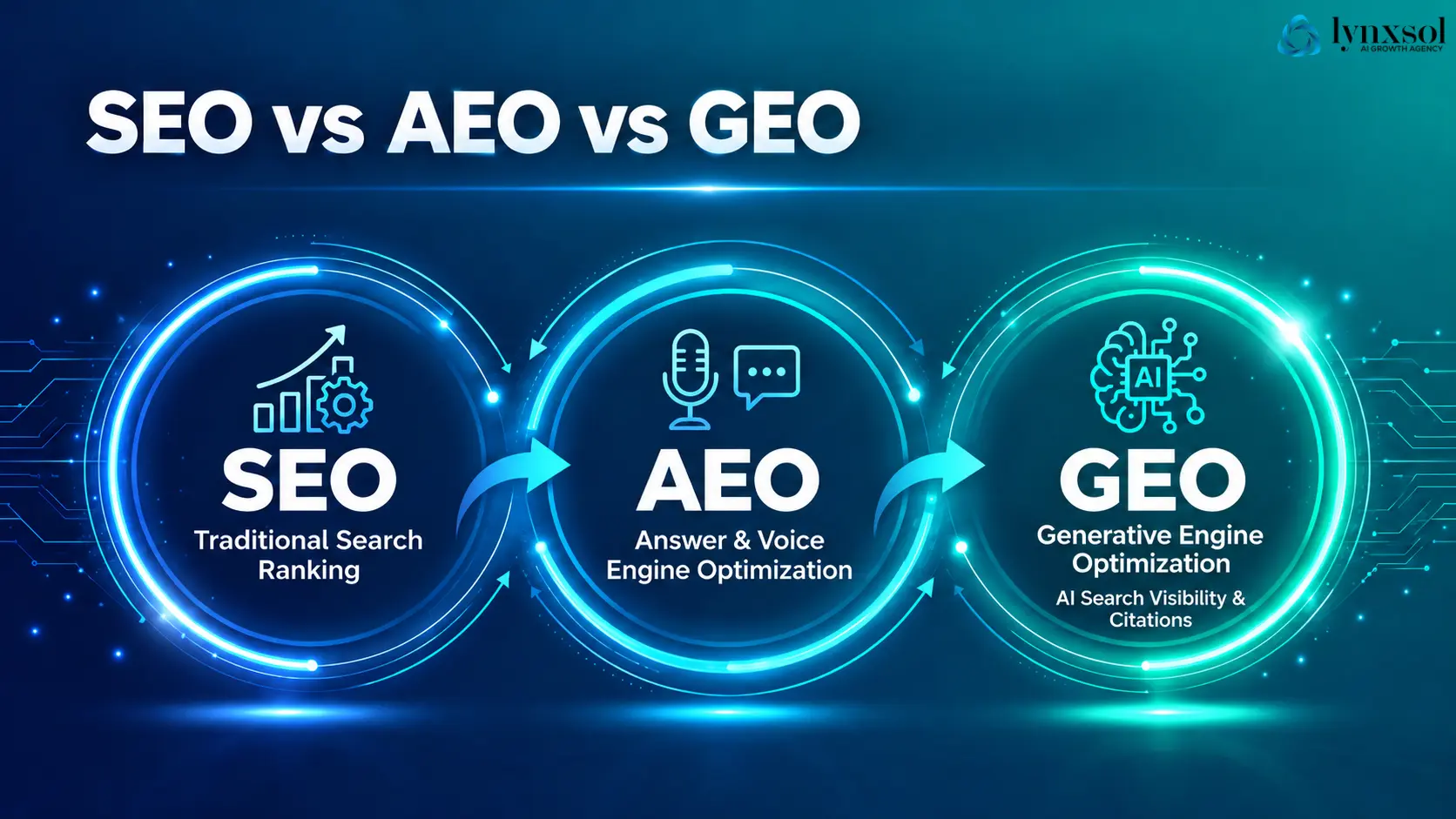
- SEO earns rankings and clicks, AEO earns the direct answer to a question, and GEO earns a citation or mention inside an AI-written response from tools like ChatGPT, Gemini or Perplexity.
- Google’s May 2026 guide says optimizing for its AI features is still SEO, but ChatGPT and Perplexity run their own crawlers, so access to those systems needs its own check.
- Clicks shrink when AI summaries appear: Pew Research found Google users clicked a traditional result in 8% of visits with an AI summary, versus 15% without one.
- Most businesses should fix SEO foundations first, add answer-ready content second, and then track AI citations with a fixed set of buyer prompts.
Introduction
If three acronyms have shown up in your last few agency calls, you are not alone. GEO vs SEO vs AEO is the comparison most business owners now meet when they ask why traffic is flat even though the brand still ranks. The short version: SEO helps your pages rank in search results, AEO helps your content become the direct answer to a question, and GEO helps AI tools cite or recommend your brand inside a generated response.
All three share most of the same groundwork. They differ in what each engine gives back, what counts as a win, and how you measure progress. At Lynxsol, we run SEO services and AI search work side by side, so this guide treats them as connected layers rather than three separate products. Below you will find plain definitions, a side-by-side table, Google’s official position, and a priority order for startups, SaaS companies, eCommerce brands and service businesses.
What Is SEO (Search Engine Optimization)?
SEO is the practice of improving a website so search engines can crawl, understand and rank its pages for relevant queries. The output is a position in a ranked list of links on the search engine results page (SERP), and the win is a click to your site.
SEO work sits in three layers:
- Technical: crawlable pages, clean indexing, fast load times, mobile usability and sensible site structure.
- Content: pages that match what the searcher wants, written with real expertise.
- Authority: links, reviews and mentions that show other people trust you.
SEO is still the foundation for the other two. Google states that its AI features are rooted in its core ranking and quality systems and pull supporting pages from its search index. If a page is not indexed, it cannot support an AI Overview.
What Is AEO (Answer Engine Optimization)?
AEO is the practice of structuring content so a search feature or assistant can lift it as the direct answer to a specific question. It grew out of the featured snippet and voice search era, when Google and assistants like Siri and Alexa started reading one answer instead of showing ten links.
Typical AEO surfaces include:
- Featured snippets at the top of Google results
- People Also Ask boxes
- Voice assistant answers
- The opening lines of an AI Overview
AEO is mostly a formatting and clarity discipline. Each key question gets its own heading, a direct answer of roughly 40 to 60 words, and then the detail. Definitions, short lists and comparison tables help because they are easy to extract.
One correction to common advice: FAQ schema is not a shortcut. Google limited FAQ rich results to well-known government and health sites in 2023, and its 2026 guidance says no special schema is required for AI features. Structured data still helps with rich results, so keep it accurate, but the answer on the page does the real work.
What Is GEO (Generative Engine Optimization)?
GEO is the practice of making your brand, products and expertise easy for generative AI systems to find, trust and cite when they write an answer. The engines include ChatGPT, Gemini, Perplexity, Claude, Microsoft Copilot and Google’s AI Mode.
The term comes from a research paper, GEO: Generative Engine Optimization, by researchers from Princeton University, IIT Delhi and other institutions, presented at the KDD 2024 conference. The authors reported that content changes can lift visibility in generative engine responses by up to 40%. Adding citations, quotations and statistics performed well in their tests, while keyword stuffing did not help.
GEO differs from SEO in two practical ways:
- More than one gatekeeper. ChatGPT search relies on OpenAI’s own crawler, OAI-SearchBot. According to OpenAI’s crawler documentation, sites that block it will not appear in ChatGPT search answers. GPTBot is a separate crawler used for model training, and blocking it does not remove you from search.
- Answers blend several sources. An AI response usually draws on multiple pages, including reviews, directories, forums and trade press. What others say about you can shape the answer as much as your own site.
Our AI search optimization services are built around these two points: crawler access first, then the facts and third-party sources that AI systems repeat.
GEO vs SEO vs AEO: Side-by-Side Comparison
The table below compares GEO vs SEO vs AEO on the same criteria, so you can see where each one fits.
| Factor | SEO | AEO | GEO |
|---|---|---|---|
| Full name | Search Engine Optimization | Answer Engine Optimization | Generative Engine Optimization |
| Main goal | Rank pages and earn clicks | Become the direct answer | Get cited or recommended in AI answers |
| Where it shows | Google and Bing organic results | Featured snippets, People Also Ask, voice, AI Overview openings | ChatGPT, Gemini, Perplexity, Copilot, Google AI Mode |
| What the engine returns | A ranked list of links | One extracted answer | A written response built from several sources |
| Unit of visibility | A ranking position | A selected passage | A citation or brand mention |
| Core tactics | Technical fixes, intent-matched content, links | Question headings, concise answers, lists and tables | Crawler access, consistent entity facts, evidence, third-party mentions |
| Main measurement | Search Console clicks, impressions, rankings | Snippet and PAA ownership, Search Console | Captured answers from a fixed prompt set, Search Console AI reporting |
The most useful distinction is the unit of visibility. SEO counts positions and clicks, AEO counts selected answers, and GEO counts citations. A page can win all three, but you have to check each one separately.
The 3 Key Differences That Actually Matter
Strip away the jargon and GEO vs SEO vs AEO comes down to three differences.
1. What the Engine Gives Back
A classic search engine returns a list and lets the user choose. An answer engine returns one passage and often ends the search there. A generative engine writes a new response and decides which sources to name. Your content strategy should match the format the engine returns for that query.
2. What a Win Looks Like
For SEO, a win is a top position and a click. For AEO, it is your wording appearing as the answer, even if no click follows. For GEO, it is your brand named in the response, ideally with a link, when a buyer asks “who should I hire” or “which product is best for this use case.”
3. How You Measure It
Measurement is where the three split most clearly. Google reports AI Overviews and AI Mode inside the normal Search Console Performance report, and its 2026 guide points site owners to a Generative AI performance report in Search Console. ChatGPT, Perplexity and Gemini have no equivalent console.
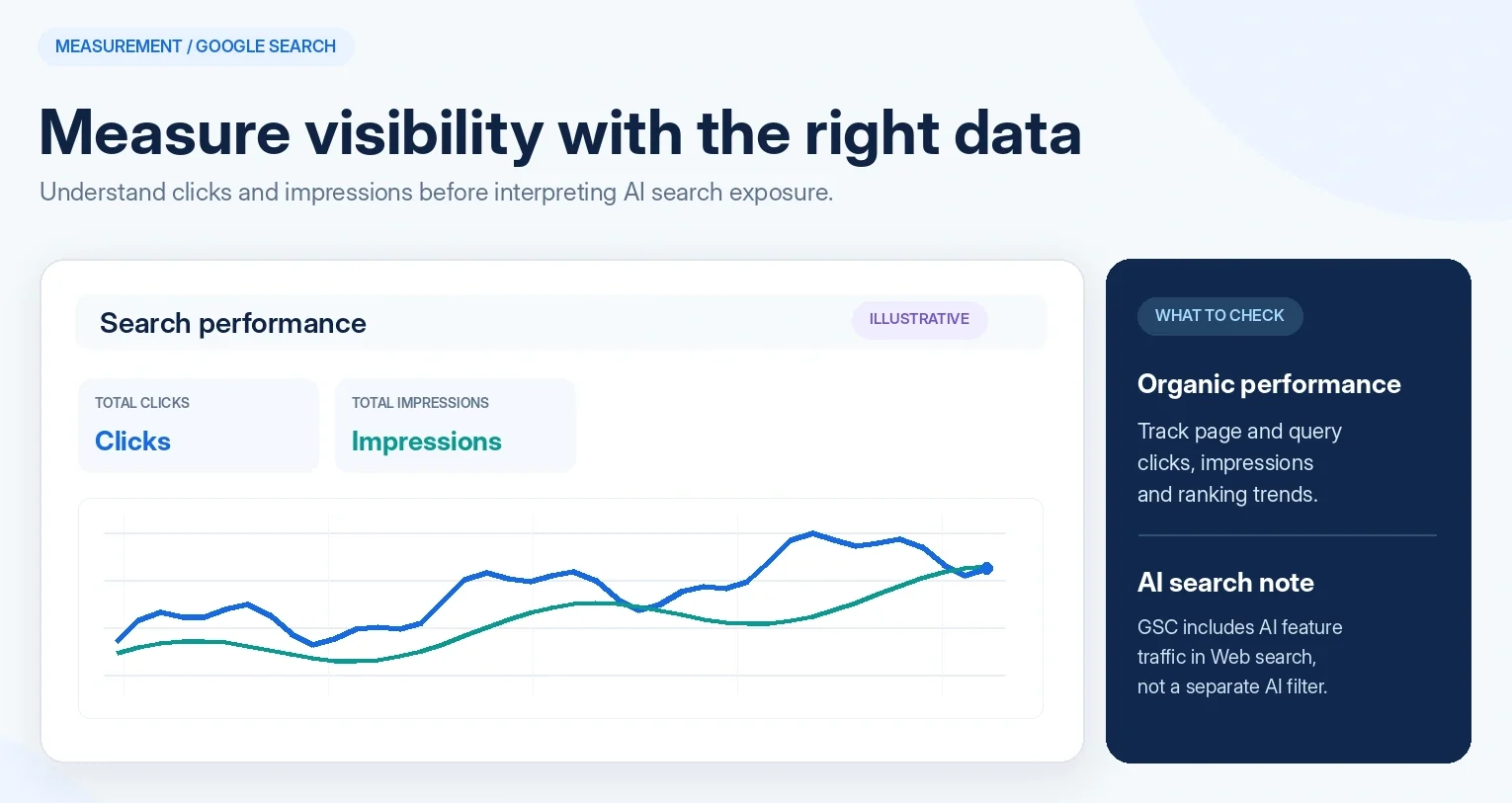
| Channel | Where to Measure | What You Can See |
|---|---|---|
| Google organic (SEO) | Search Console, Google Analytics | Clicks, impressions, average position, conversions |
| Google answer features (AEO) | Search Console, manual SERP checks | Snippet and People Also Ask ownership, query-level impressions |
| AI assistants (GEO) | Fixed prompt set run on a schedule | Whether you are mentioned or cited, and which competitors appear instead |
Treat AI assistant tracking as sampled visibility, not full attribution. Keep the prompt list fixed from month to month, or you cannot tell real movement from noise.
Where SEO, AEO and GEO Overlap: Google’s Official Position
On May 15, 2026, Google published Optimizing your website for generative AI features on Google Search. It defines AEO and GEO, then states that, from Google Search’s point of view, optimizing for generative AI search is still SEO.
The guide also lists tactics you can ignore for Google Search:
• llms.txt files and other special AI markup
• “Chunking” content into tiny pieces
• Rewriting content just for AI systems
• Chasing inauthentic mentions
• Overfocusing on structured data
Google adds a warning that matters for anyone tempted to mass-produce pages. Creating separate pages for every variation of a question, mainly to influence rankings or AI responses, can violate its scaled content abuse policy. If you publish at volume, read our breakdown of Google’s August 2026 spam update before building pages around fan-out queries.
Google’s position covers Google Search only. ChatGPT, Perplexity and other assistants use their own crawlers and their own source selection. The honest summary of GEO vs SEO vs AEO is one foundation with separate scoreboards: the groundwork is shared, but you still have to confirm that each system can reach you and test what each one says.
We see the same pattern in client work. The Dungeon Geek earned a Google AI Overview citation alongside a technical cleanup of 90 site errors, and Ethan Hutchinson’s site began receiving direct ChatGPT recommendations after its technical SEO was rebuilt. In both cases the AI visibility followed the fundamentals rather than replacing them.
Why the Shift Matters: Fewer Clicks, More Answers
AI summaries change how much traffic a ranking delivers. A Pew Research Center analysis of Google searches from 900 U.S. adults in March 2025 found:
• 18% of searches produced an AI summary.
• Users clicked a traditional result in 8% of visits with a summary, compared with 15% without one.
• Only 1% of visits included a click on a link inside the summary itself.
• 60% of searches starting with question words such as “what” or “why” produced a summary.
Google disputes part of this picture. It says clicks from results pages with AI Overviews are higher quality, meaning visitors tend to spend more time on the site.
Both points lead to the same conclusion. Fewer searchers will click, so being the name inside the answer matters more. The visitors who do click often arrive better informed, so the page they land on needs to convert.
Which Should You Prioritize? A Practical Order
For most businesses weighing GEO vs SEO vs AEO, the right order is SEO foundations, then AEO formatting, then GEO measurement and outreach. Each step makes the next one work.
1. Fix access and indexing. Confirm your key pages are indexed in Search Console. Allow Googlebot, Bingbot and OAI-SearchBot in robots.txt and at your CDN. Make sure core text sits in the HTML rather than appearing only after JavaScript runs. A fast, mobile-friendly build from responsive web design services supports all three channels.
2. Answer real buyer questions. Build pages around the questions your sales team hears: scope, price ranges, timelines, comparisons and suitability. Put a direct answer near the top of each section.
3. Make your facts consistent. Use the same business name, services, locations and descriptions on your site, Google Business Profile, Merchant Center feed, directories and review platforms.
4. Earn genuine mentions. Reviews, trade coverage, comparison roundups and expert contributions give AI systems independent sources to cite.
5. Measure each scoreboard. Track Search Console for Google and a fixed prompt set for ChatGPT, Gemini and Perplexity. Review monthly.
Priority by Business Type
The order above holds for everyone, but the emphasis shifts with your business model.
| Business Type | Start With | Then Add | Watch For |
|---|---|---|---|
| Local service business | Google Business Profile, location pages, reviews | Answers to cost, timing and service-area questions | Inconsistent addresses or service areas across directories |
| eCommerce brand | Crawlable product and category pages, product data | Buying guides and product comparisons | Out-of-date price and stock data in feeds and markup |
| SaaS company | Technical SEO, use-case and integration pages | Honest comparison pages, review platform profiles | AI answers repeating old pricing or retired features |
| Startup or new site | Indexing, a few strong core pages | Founder expertise, early press and reviews | Expecting AI citations before the site has search visibility |
| B2B service provider | Service pages that state scope and process | Case studies with named results, industry mentions | Vague copy that gives AI systems nothing specific to repeat |
Common Mistakes When Comparing GEO vs SEO vs AEO
- Buying three separate retainers. Most of the work overlaps. Paying three vendors for the same technical and content fixes wastes budget.
- Blocking AI search crawlers by accident. Some CDN bot settings block OAI-SearchBot or confuse it with GPTBot. Check your logs and settings before writing new content.
- Mass-producing question pages. Thin pages built for every variation of a query add risk under Google’s spam policies and rarely earn citations.
- Treating llms.txt as a Google ranking lever. Google says its search systems ignore it. It may matter to other services, but it is not a priority fix.
- Reporting visibility scores without evidence. A score with no captured AI answers behind it tells you very little. Ask to see the actual responses.
- Chasing paid or fake mentions. Google states its AI features depend on the same spam-fighting systems as regular search.
Frequently Asked Questions
Is GEO replacing SEO?
No. In the SEO vs GEO debate, GEO builds on SEO rather than replacing it, even when vendors sell it as AI SEO. Google’s AI features pull supporting pages from its search index, and many AI assistants retrieve live web results before writing an answer. If your pages cannot be crawled, indexed and understood, they are unlikely to be cited. GEO adds work on top: crawler access for AI systems, consistent brand facts, third-party mentions and prompt-based tracking.
Is AEO the same as GEO?
They overlap heavily, and many marketers use the terms interchangeably. The usual distinction is emphasis. AEO focuses on being the single direct answer to a specific question, such as a featured snippet or a voice result. GEO focuses on being cited or recommended inside a longer response that an AI system writes from several sources.
What is the difference between AEO vs SEO?
SEO aims to rank a page in a list of results so people click through to your site. AEO aims to have your content selected as the answer itself, often shown on the results page or read aloud by an assistant. SEO’s unit of success is a ranking and a click. AEO’s is a selected passage, which may not produce a click at all.
How do I get my business mentioned by ChatGPT?
Three things need to be true. ChatGPT’s search crawler, OAI-SearchBot, must be allowed to reach your pages. The facts about your business must be consistent across your site and trusted third-party sources. And a page must answer the buyer’s question with specific detail rather than sales copy. No one can guarantee a mention, because each assistant chooses its own sources at query time.
Do I need llms.txt or special schema for AI search?
Not for Google. Google’s 2026 guide says its search systems ignore llms.txt and that no special schema.org markup is needed for AI features. Creating an llms.txt file will not hurt, and some other services may use it. Keep standard structured data accurate and matched to visible content, since it still supports rich results.
How do I measure AI search visibility?
Use two methods. For Google, check the Search Console Performance report, which includes AI Overviews and AI Mode, and Google’s Generative AI performance report. For ChatGPT, Gemini and Perplexity, run a fixed list of buyer prompts on a regular schedule and record which brands each one names. That gives you sampled visibility, not complete data, so track the trend over several months.
How much do generative engine optimization services cost?
Pricing varies widely by scope, number of tracked prompts and how much implementation is included. Lynxsol publishes its generative engine optimization services plans on the service page at $499, $999 and $1,499 per month. When comparing providers, ask what work gets published each month and whether reports include the captured AI answers.
Conclusion
The GEO vs SEO vs AEO debate is less about choosing one and more about sequence. SEO makes your pages findable, AEO makes your answers easy to lift, and GEO makes your brand the one AI tools name when buyers ask for a recommendation. Start with access and indexing, write pages that answer real questions, keep your facts consistent, and measure Google and AI assistants as separate scoreboards.
If you want SEO, AI search and paid media handled under one plan, take a look at our complete growth package. Or book a scoping call and we will show you what ChatGPT, Gemini and Google’s AI Overviews currently say when your buyers ask about your category.